GST E-Invoice Template for Business Billing
Save time and reduce errors with our GST E-Invoice formats. It helps you manage and issue e-invoices seamlessly. It can be modified to meet certain business requirements. Start customizing the templates.
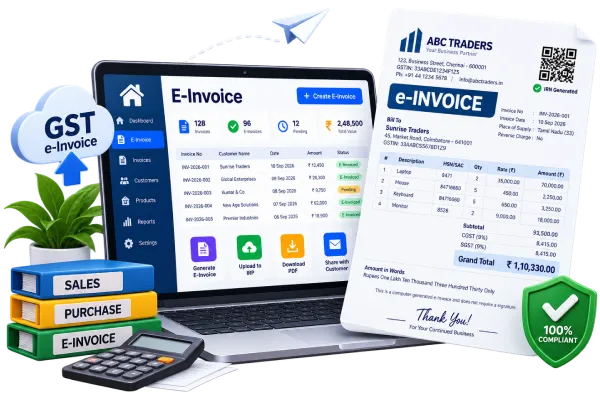
Save time and reduce errors with our GST E-Invoice formats. It helps you manage and issue e-invoices seamlessly. It can be modified to meet certain business requirements. Start customizing the templates.
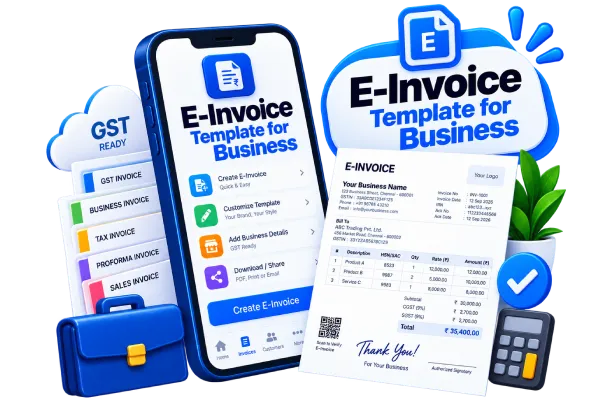
GST E-Invoice format increases the efficiency of the invoicing process by streamlining it. By providing timely changes to billing data, e-invoicing encourages accuracy in financial operations.
Businesses improve efficiency by implementing this solution. They also make sure that industry and legal standards are followed.
GST invoicing with reliable accounting software ensures standardization and auto-validation. When filing GST returns, it minimizes inconsistencies and gets rid of mismatched data.
GST E-invoice format ensures timely management of your payables and receivables. Better cash flow management is ensured by prompt invoicing and faster ITC processing.
Your business transactions are made more trustworthy when your invoices are created and verified via the GST portal. Partners, suppliers, and customers all feel better at ease.
With key features, GST e-invoicing can be easily included in your current accounting process. This enables you to manage several tasks.
E-invoices are digitally preserved and readily available at any moment. Audits and evaluations are made easier as a result.
Businesses can avoid fines for late or wrong filing by using cloud-based GST billing software. This aids in keeping abreast of the most recent GST regulations and modifications.
Paper-based invoices may no longer be necessary thanks to electronic invoicing. As a result, you may be able to reduce expenses and waste related to paper-based supply chain procedures.
The e-way bill does not require you to type separate sheets. From the invoice, the system generates e-way bill details. It assists in assigning a distinct IRN and QR code to each invoice.
Gather all pertinent information. Additionally, make sure you have the client's GST details, HSN/SAC codes, and applicable tax rates needed for e-invoicing compliance.
Make a structured template with fields for the total invoice amount, taxable value, GST (CGST, SGST, and IGST), and invoice information.
Add all e-invoicing fields, including GSTINs for suppliers and buyers, HSN/SAC codes, supply location, invoice type, terms of payment, and other regulatory requirements.
Adapt the templates to the specifics of your company. Automation increases accuracy, reduces manual data entry, and expedites the creation of invoices.
Examine every aspect of the invoice, verify the data, create the necessary IRN and QR code, and send the customer the completed electronic invoice.
The Indian government uses the GST E-invoicing format, a standardized digital template, to verify and monitor business-to-business (B2B) transactions. The eight salient features of this format are as follows:
The following lists the various GST E-invoice formats that companies employ in various transaction scenarios.
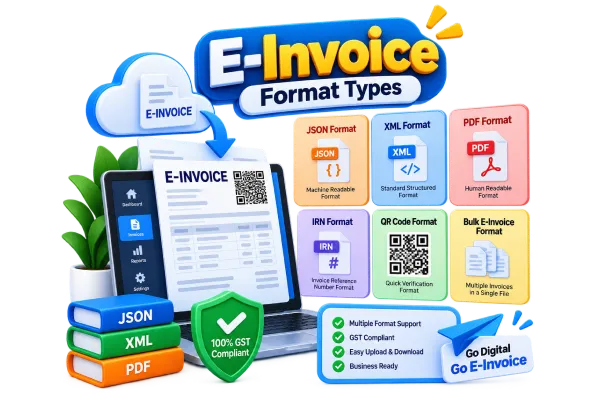
B2B GST E-Invoice Format: Transactions between two GST-registered companies utilize this format. It contains the required buyer and supplier information.
GST E-Invoice Export Format: Businesses exporting goods or services outside of India are the target audience for the export e-invoice format. It includes export-specific facts, including the destination country and shipping information.
E-Invoice Format for Credit Notes: When the seller needs to lower the value of an earlier invoice because of adjustments, they issue a credit note e-invoice. The updated taxable value and GST amounts are included.
Debit Note E-Invoice Format: This format is used when extra charges need to be added to an already issued invoice. It records the increased taxable value and revised GST liability.
Service GST E-Invoice Format: A service E-invoice format is used by businesses providing professional or commercial services. It includes service details, SAC codes, service charges, and more.
POS-Generated GST E-Invoice Format: This format is automatically generated through ERP, accounting, or POS software integrated with the GST Invoice Registration Portal (IRP).




