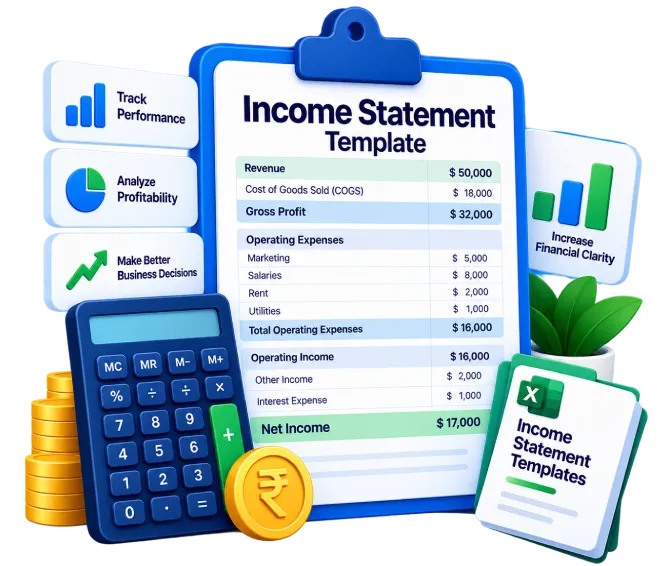
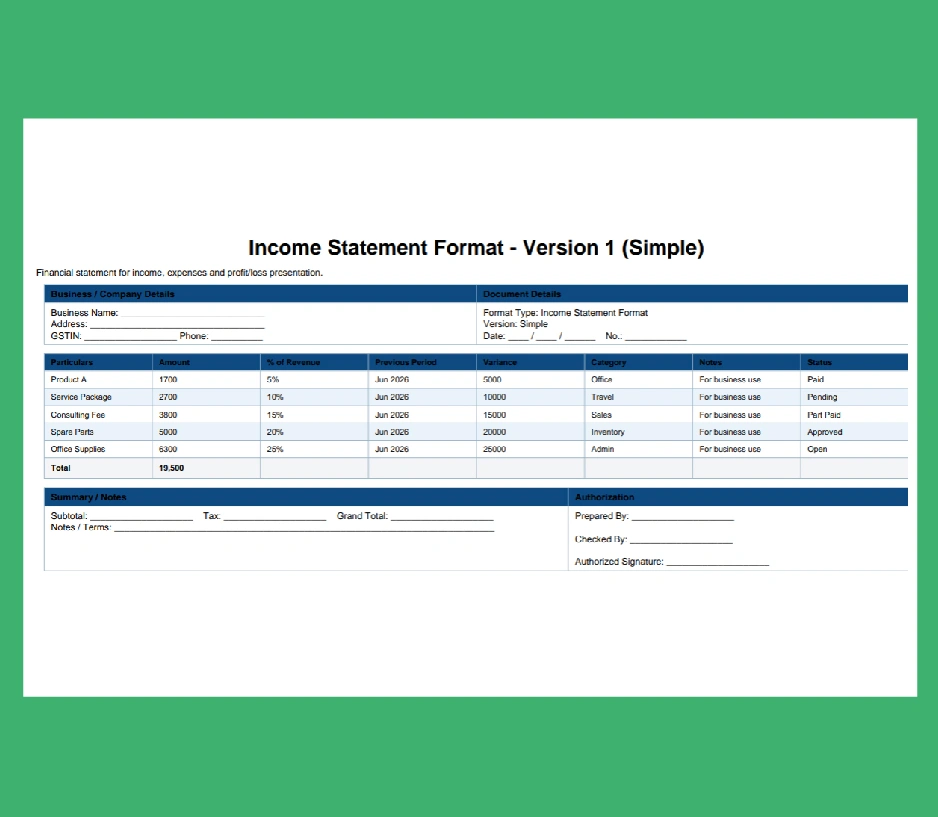
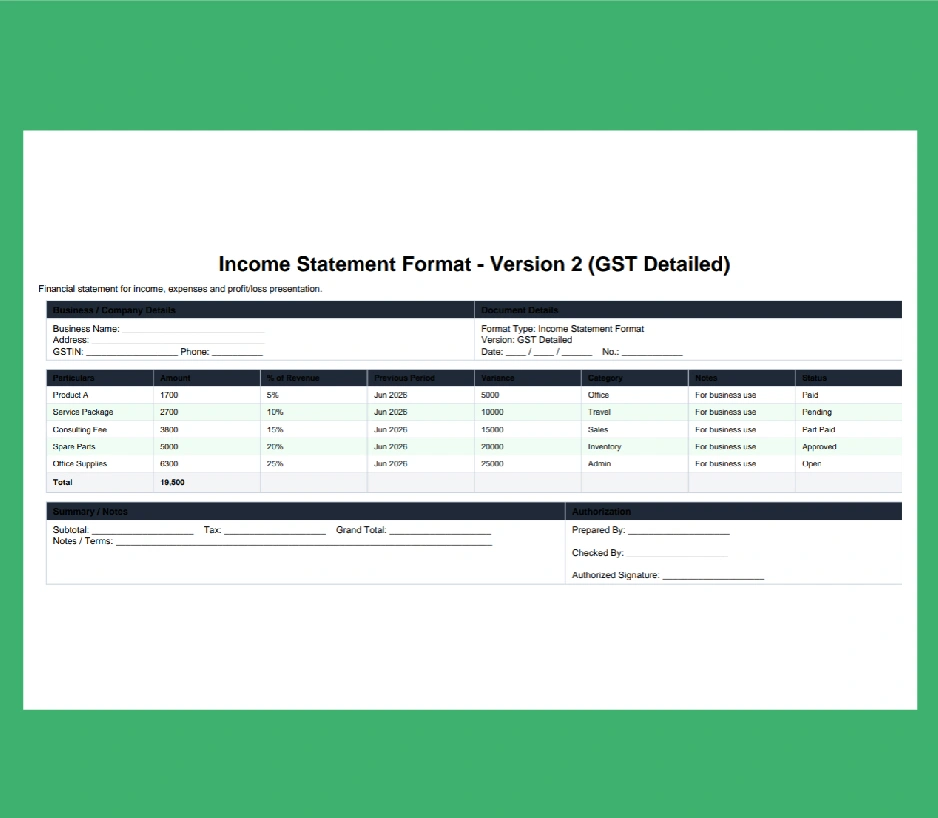
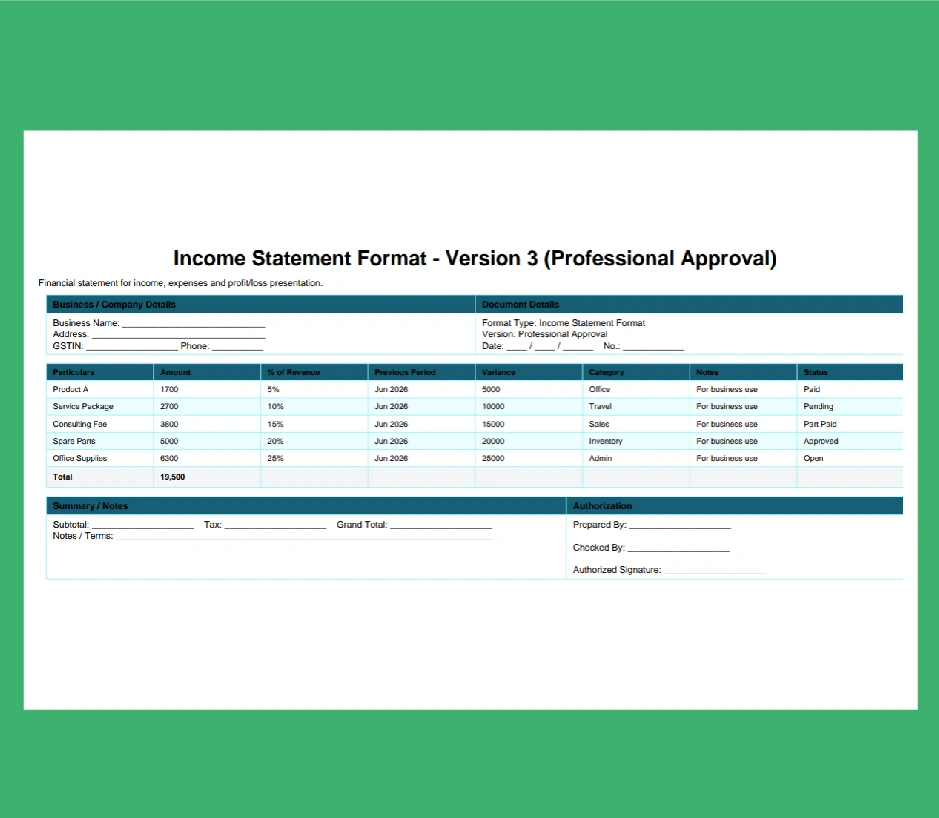
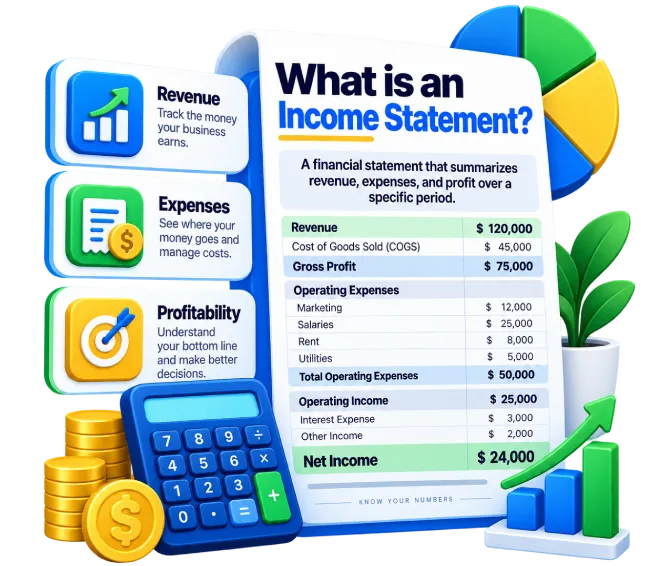
Get detailed reporting on revenue, expenses, gains, and losses with the essential financial statement format. It serves as a financial document to improve profitability and helps in making data-driven decisions.
An income statement shows the income generated and expenses incurred by a business over a defined period.
It helps business owners, accountants, and stakeholders evaluate profitability, track financial performance, and make informed business decisions.
An income statement template clearly helps owners evaluate whether a business has earned a profit or incurred a loss.
The financial statement format helps to make informed decisions regarding budgeting, and future investments with accurate insights on revenue and net income.
Businesses can track revenue patterns by comparing income statements from various time periods. Frequent analysis helps assess the success of marketing and sales tactics.
The format categorizes operating and non-operating expenses, making it easier to identify unnecessary costs to increase overall profitability.
The financial information needed to determine taxable income is arranged in an income statement. Precise documentation minimizes mistakes and speeds up and improves the efficiency of tax filing.
Investors, banks, and financial institutions use a well-prepared statement to assess a company's financial stability and earning potential. A well-prepared statement increases credibility and supports funding or loan applications.
The sources of income and spending trends for a certain time period are highlighted in the income statement. Businesses can utilize this data to create attainable financial objectives and realistic budgets.
Businesses can compare their financial performance across several months, quarters, or years using an income statement template. It helps in creating plans for ongoing development.
A certain period of time, such as a month, a quarter, or a full fiscal year, must be included in each income statement.
Before making any deductions to determine your gross revenue, compile your sales records, invoices, and receipts.
COGS comprises all direct expenses directly related to the manufacturing of the products or services you offer.
Use the correct formula to calculate the amount of money your business keeps from sales before making daily operational expenses.
Enumerate all the indirect costs incurred by your business, including non-operating (such as income taxes and loan interest) and operating (such as daily expenses).
An effective income statement captures the key financial details that provide a complete picture of a company's operational and financial performance.
An income statement, sometimes referred to as a P&L statement format, displays a company's financial performance over a certain time period by breaking down revenues, expenses, profits, and losses. Companies display this information in six primary formats, such as:
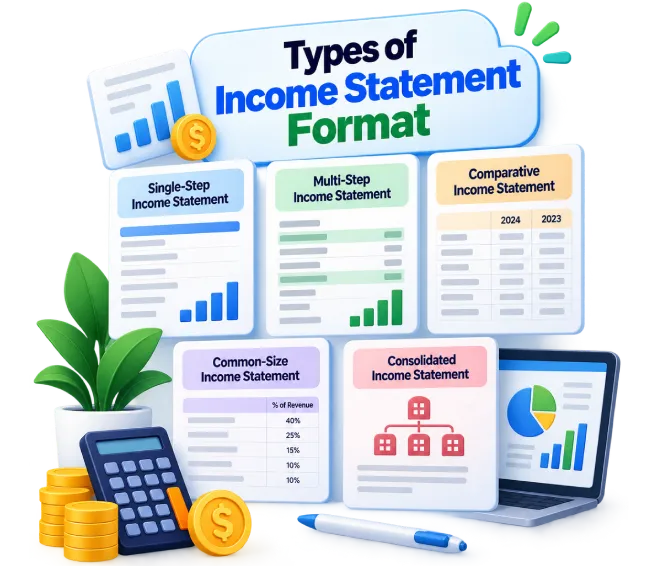
Single Step Format: Makes use of one simple equation. It is perfect for relatively small enterprises with straightforward operations because it aggregates all income and expenses.
Multiple-Step Structure: Divide income and costs into groups for operations and non-operations. It provides more in-depth operational insights by calculating gross profit, operating income, and net income.
Comparative Format: Displays financial data for several reporting periods side by side. Growth, declining patterns, and business seasonality are shown in this style.
Common-Size Format: Calculates the proportion of total income for each line item. This makes it easier to compare your business's financial structure against competitors of varying sizes.
Segmented Format: This helps to spot out which areas of the business are the most or least profitable by categorizing the financial performance based on departments or geographic locations.
Contribution Margin Format: Separate expenses into variable and fixed costs. It is highly useful for internal management decision-making, break-even analysis, and pricing strategies.