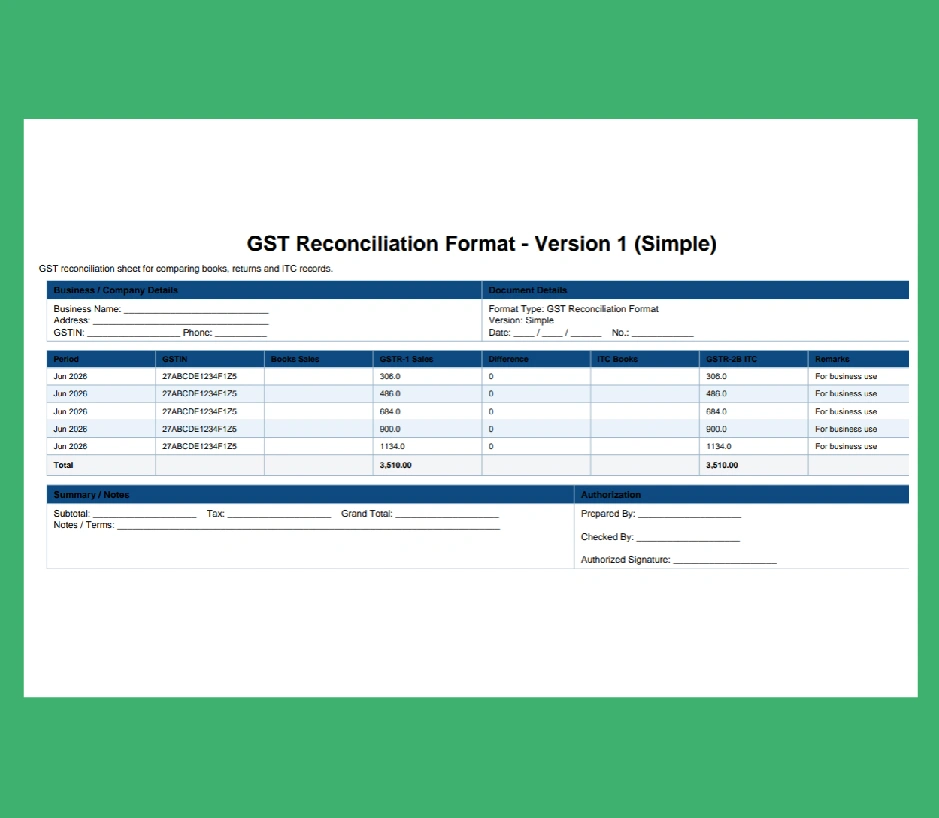
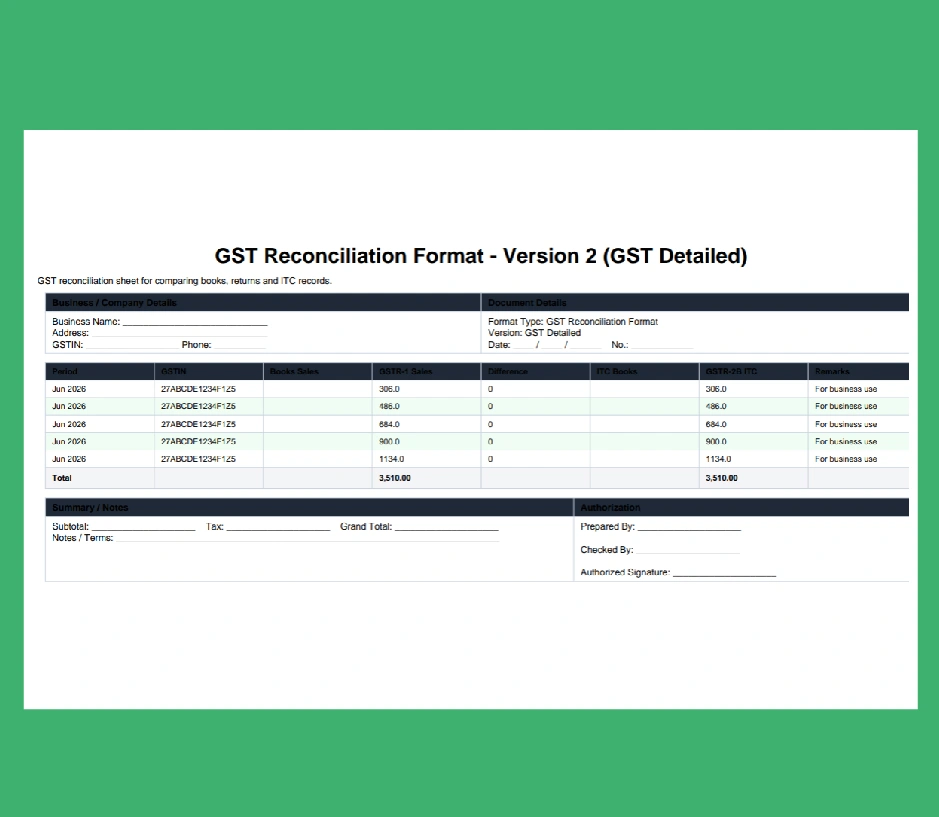
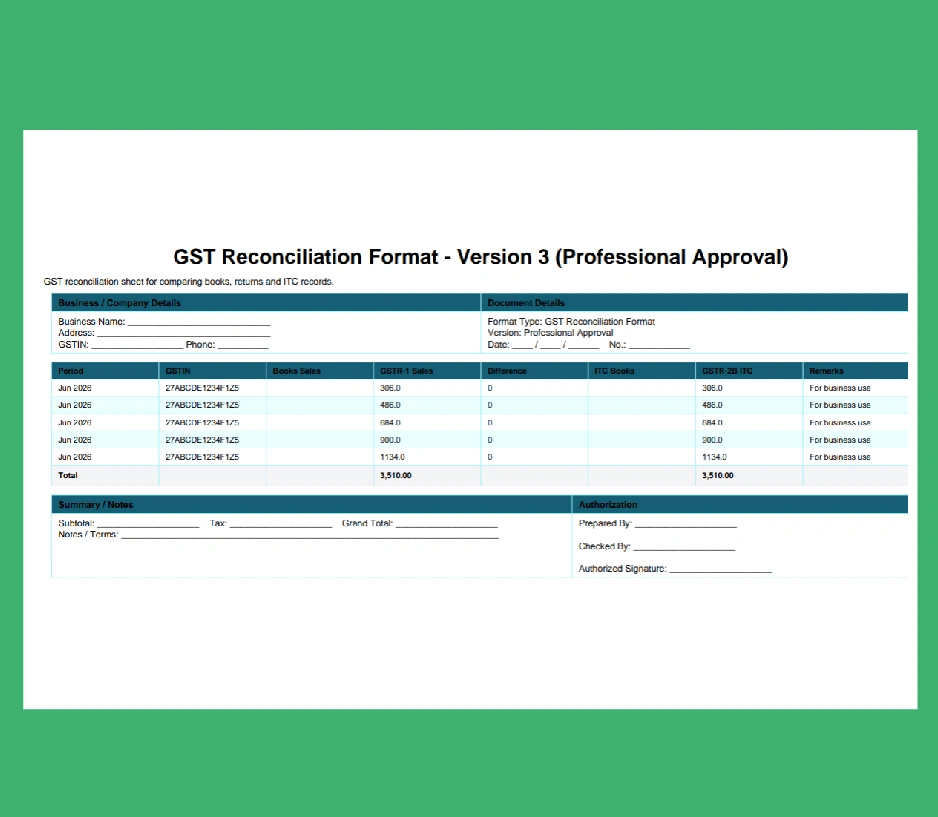
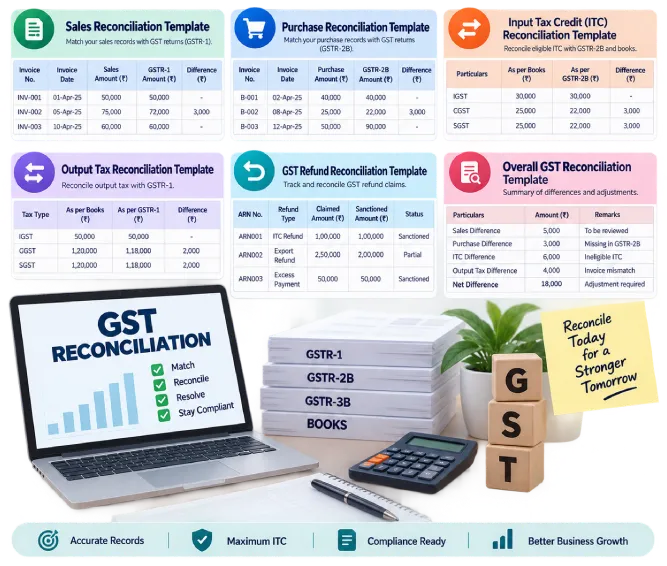
Use the customizable GST reconciliation format to fix the mistakes in your GST returns. For precise computations, use expert templates. It ensures that the entries in their book of accounts correspond to the returns that are filed.
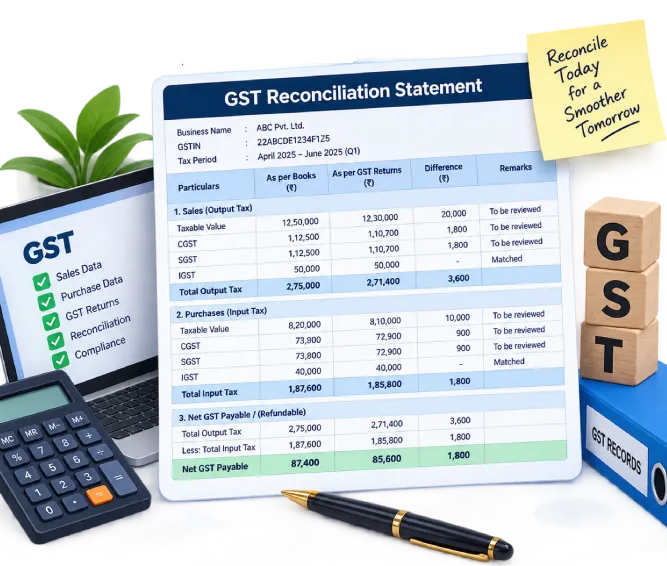
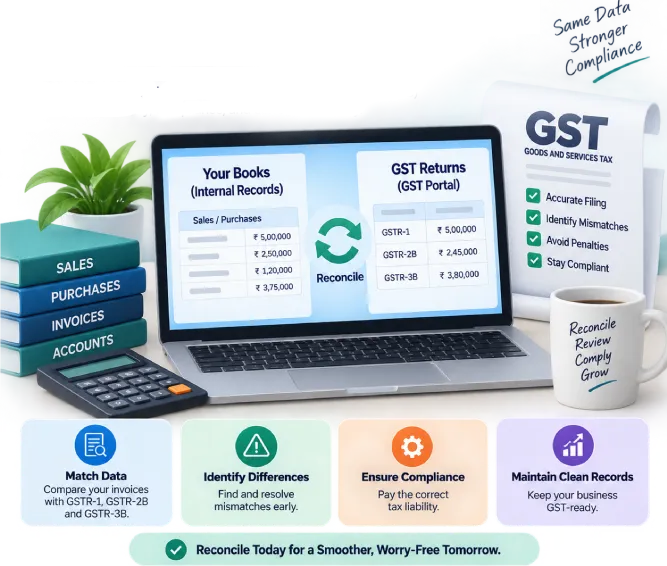
GST reconciliation is the process of comparing the GST details reported in your returns with your books of accounts to identify and resolve any differences. It helps businesses verify sales, purchases, and Input Tax Credit (ITC) details for accuracy.
By maintaining proper GST reconciliation records, businesses can reduce filing errors, avoid compliance issues, claim eligible ITC, and ensure accurate tax reporting.
Precise financial accounts are provided by accurate GST reconciliation. This helps with the preparation of tax records, yearly financial reports, and future financial needs.
In the event of discrepancies, GST reconciliation assists in keeping transparent records that are shared with vendors. This improves relationships and fosters confidence between suppliers and vendors.
The simplicity of the input tax credit (ITC) is a significant advantage of GST. It lowers the total tax liability and maximizes ITC claims.
By verifying purchase invoices and GST details, reconciliation helps prevent incorrect ITC claims and reduces the chances of future reversals.
GST reconciliation helps identify differences between the supplier's submitted records and the company's records. Providing correct GST returns that accurately depict transactions is beneficial.
Penalties and rising tax interest are the outcomes of filing false GST returns. Reconciling the data regularly assists in maintaining accurate records and avoiding penalties for non-compliance.
One of the important highlights is reconciliation reduces your work burden. This frees up vital staff time so they can focus on more important company tasks.
You get access to comprehensive reports and dashboards that provide you with details about your company's tax obligations and GST compliance status. You can take the appropriate action thanks to this visibility.
Collect all relevant accurate GST documents, including sales invoices, purchase invoices, credit notes, debit notes, and GST return data to avoid discrepancies.
Design a template with essential columns such as invoice number, invoice date, supplier details, GSTIN, taxable value, GST amount (CGST, SGST, IGST), return and reconciliation status.
Compare invoice details, tax amounts, and GSTINs to identify missing invoices, duplicate entries, or tax calculation differences.
Review all mismatched transactions and investigate the reasons; correct errors such as incorrect GSTINs, tax amounts, or missing entries before filing GST returns.
Finalize and maintain the reconciliation report. Save the completed template for future audits.
By combining accuracy and compliance, GST reconciliation mitigates penalties. Here are the ultimate highlighted aspects that you receive in choosing the effective GST reconciliation of returns.
Are you worried about accurate GST compliance and financial reporting? Here are the difference types of GST reconciliation templates available.
Sales GST Reconciliation: This template compares sales invoices recorded in the accounting system with GST return data. It helps identify mismatches in GST amounts and invoice details before filing returns.
Purchase GST Reconciliation: A purchase GST matching format matches purchase invoices with supplier-uploaded invoices and Input Tax Credit (ITC) records. It ensures businesses claim eligible ITC accurately.
GSTR-1 Reconciliation: A GSTR-1 reconciliation statement compares outward supply records with the details reported in GSTR-1. It ensures sales data are complete and consistent with business records.
GSTR-2B Reconciliation: This template reconciles purchase records with the auto-generated GSTR-2B statement. It helps verify eligible input tax credits and identify discrepancies before filing GST returns.
Input Tax Credit (ITC) Reconciliation: Eligible input tax credits are checked against purchase invoices and GST portal data using an ITC reconciliation statement. It assists companies in making the most of their GST-compliant credits.
Annual GST Reconciliation Template: The entire year's accounting records and all the GST returns submitted during the fiscal year are compared in an annual GST reconciliation statement format.