
This is where restaurant POS software can make a real difference. A modern POS is no longer limited to processing payments or printing receipts. It can connect sales, inventory, accounting, and tax management within one system.
But different restaurants have different requirements. A growing cafe may value simplicity and easy billing, while a large restaurant chain may need advanced kitchen controls and enterprise-level integrations.
This Raseed vs POSist comparison looks at how both platforms approach restaurant billing, kitchen operations, inventory, and financial management, helping you understand which one may be a better fit for your business.
Raseed vs POSist: An Overview
Raseed Billing Software
For businesses that want essential restaurants and financial functions working together, Raseed provides an accessible solution without adding unnecessary complexity.
POSist
This makes the comparison between Raseed vs POSist less about which platform has more features and more about which system matches the way your restaurant operates.
Feature Comparison for Raseed vs POSist
1.Ordering and Billing Workflow
Billing is at the centre of restaurant operations, but an effective POS needs to do more than generate a receipt.
Raseed provides a complete billing workflow for restaurant teams, including menu-based billing, table management, order processing, discounts, multiple payment modes, and GST-compliant invoicing. Barcode scanning also supports quick billing for packaged or quick-service items. Because billing is connected with the wider Raseed platform, transactions can contribute directly to sales analysis, inventory visibility, payment tracking, and financial records.
3.Inventory and Recipe Management
Restaurant profitability depends heavily on how well stock is controlled. Ingredients need to be available when required; purchases need to be recorded, and stock movement needs to remain visible.
Raseed provides real-time inventory management with low-stock alerts, purchase management, multi-warehouse support, stock tracking, and item-level profitability information.
The important part is the connection between these functions. Purchases can be tracked alongside inventory, while sales provide visibility into how products and items are moving. This gives restaurant owners a more complete view of stock and purchasing activity instead of treating inventory as an isolated function.
POSist also provides inventory and restaurant supply management capabilities, helping businesses manage stock and related operational requirements.
Raseed takes this a step further by connecting inventory activity with the wider business and financial management environment.
4.Accounting and Financial Management
A restaurant may process hundreds of transactions in a day. If those transactions do not translate into useful financial information, owners still have to spend time bringing the numbers together.
Raseed includes accounting as part of its platform. Sales, expenses, receivables, payments, and other transactions can be managed within the same system. It also provides financial reports such as Profit & Loss and balance sheet information, helping owners move from simply knowing how much they sold to understanding the financial performance of the business.
POSist provides restaurant reporting and integrations that can connect operational information with other business systems and financial workflows.
For restaurants looking for a POS that also acts as a broader business management system, Raseed offers a more integrated approach by keeping operational and financial information within the same platform.
Raseed vs POSist: Quick Comparison
|
Feature
|
Raseed
|
POSist
|
|---|---|---|
|
Platform Scope
|
Restaurant operations + business management
|
Restaurant operations management
|
|
Multi-Location Support
|
✓ Yes
|
✓ Yes
|
|
User Permissions
|
✓ Role-based access
|
✓ User access controls
|
|
Reporting Focus
|
✓ Operational + financial insights
|
✓ Restaurant-focused management
|
|
Business Management
|
✓ Integrated business functions
|
✓ Restaurant & operational insights
|
|
Cloud Accessibility
|
✓ Yes
|
✓ Supported
|
|
Overall Approach
|
Connected restaurant & business management platform
|
Restaurant management platform
|
Why Raseed Is the Best Restaurant POS Software
Choosing a POS should not be about having the longest feature list. The right choice depends on how your restaurant operates every day. Raseed can be a practical choice for:
Small and Medium-Sized Restaurants
Raseed is designed for businesses that need essential restaurant operations without the complexity of an enterprise-level setup. It can work for restaurants, cafés, QSRs, and food trucks.
Quick Setup and Easy Adoption
Restaurant staff can start using the system without extensive training. This makes it easier to introduce the software into daily operations without spending significant time on complicated onboarding.
Connected Billing and Accounting
Sales do not have to remain separate from financial management. Raseed connects POS billing with accounting, helping owners maintain a clearer picture of revenue, expenses, receivables, and profitability.
GST and Tax Management
The software can automatically calculate applicable GST and maintain related records. It also supports credit notes and E-Way bills to simplify tax-related processes.
Flexible Device Access
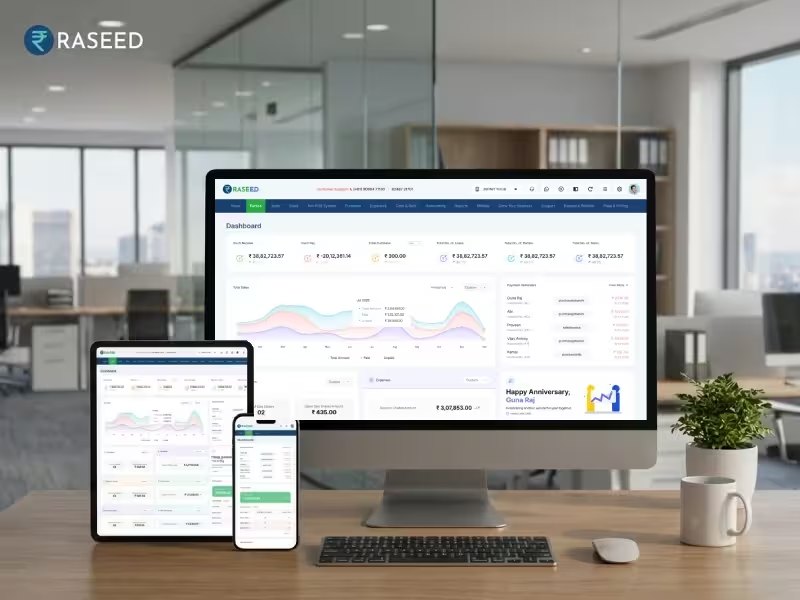
Raseed can be accessed across desktops, tablets, and mobile devices, giving owners more flexibility in how they monitor and manage the business.
Inventory Visibility
Restaurant owners can monitor stock across multiple warehouses, set low-stock alerts, and keep track of item-level profitability. This can help prevent avoidable stock shortages and improve purchasing decisions.
Controlled User Access
Role-based permissions allow businesses to decide what different employees can access. This provides greater control over sensitive business and financial information.

GST Billing & Invoicing Software
Category List
Transform your billing with our top-notch software. Fast, accurate invoicing—start optimizing today!
